Investing
indie Semiconductor Posts 31% Revenue Gain, Bets on Humanoid Robots After Wuxi Exit
By Bear Creek Staff, . Bear Creek Capital Network.
indie Semiconductor's third quarter showed the company pulling in two directions at once: a core automotive business gaining momentum and a Chinese subsidiary dragging on margins ahead of a planned exit. The earnings call transcript, published by The Motley Fool, and the accompanying SEC Form 8-K filing lay out the numbers and the strategic pivot in detail.
What the quarter delivered
Revenue came in at $70.2 million, ahead of the midpoint of guidance. Core business revenue, which strips out the Wuxi subsidiary, reached $40.7 million, a 14% sequential gain driven by share wins and new program ramps in the Advanced Driver Assistance Systems (ADAS) portfolio. ADAS refers to technologies designed to increase vehicle safety and automate driving tasks.
The non-GAAP operating loss narrowed to $7.2 million from $11.3 million in the same quarter a year earlier. Non-GAAP net loss per share improved by two cents to $0.05, based on 233 million weighted average shares. Cash stood at $144.3 million, down $4.7 million from the second quarter.
The Wuxi unit, a China-based business indie is selling to United Faith Auto-Engineering Co., Ltd. for $135 million in gross proceeds, contributed $29.5 million in revenue, a 5% sequential rise. But CFO Wu acknowledged, per the transcript, that the segment has faced what the company described as "fairly severe margin pressure over the course of the last I mean, 9 to 12 months or so," pulling consolidated gross margins down to 41.6%. Soft demand in China's automotive market during the quarter added to the pressure.
The Wuxi exit and what replaces it
Management is treating the divestiture as a clean break. The fourth-quarter outlook assumes Wuxi contributes $30 million in revenue if the sale does not close before year-end, while the core business is guided to $47 million. Total fourth-quarter revenue guidance is $73 million to $81 million, implying roughly 33% year-over-year growth at the midpoint.
Once the deal closes, management expects organic growth in radar and vision products to more than offset the lost Wuxi revenue in 2027. The company's radar chipset is now in high-volume production, priced at $5 to $6 per unit, with peak annual volume targets of 50 million to 70 million units. The radar platform was selected by one of the three largest North American automakers, according to the transcript.
Software royalties from in-cabin sensing and perception products are expected to generate $4 to $8 per unit, adding a recurring revenue layer on top of hardware sales.
The physical AI bet
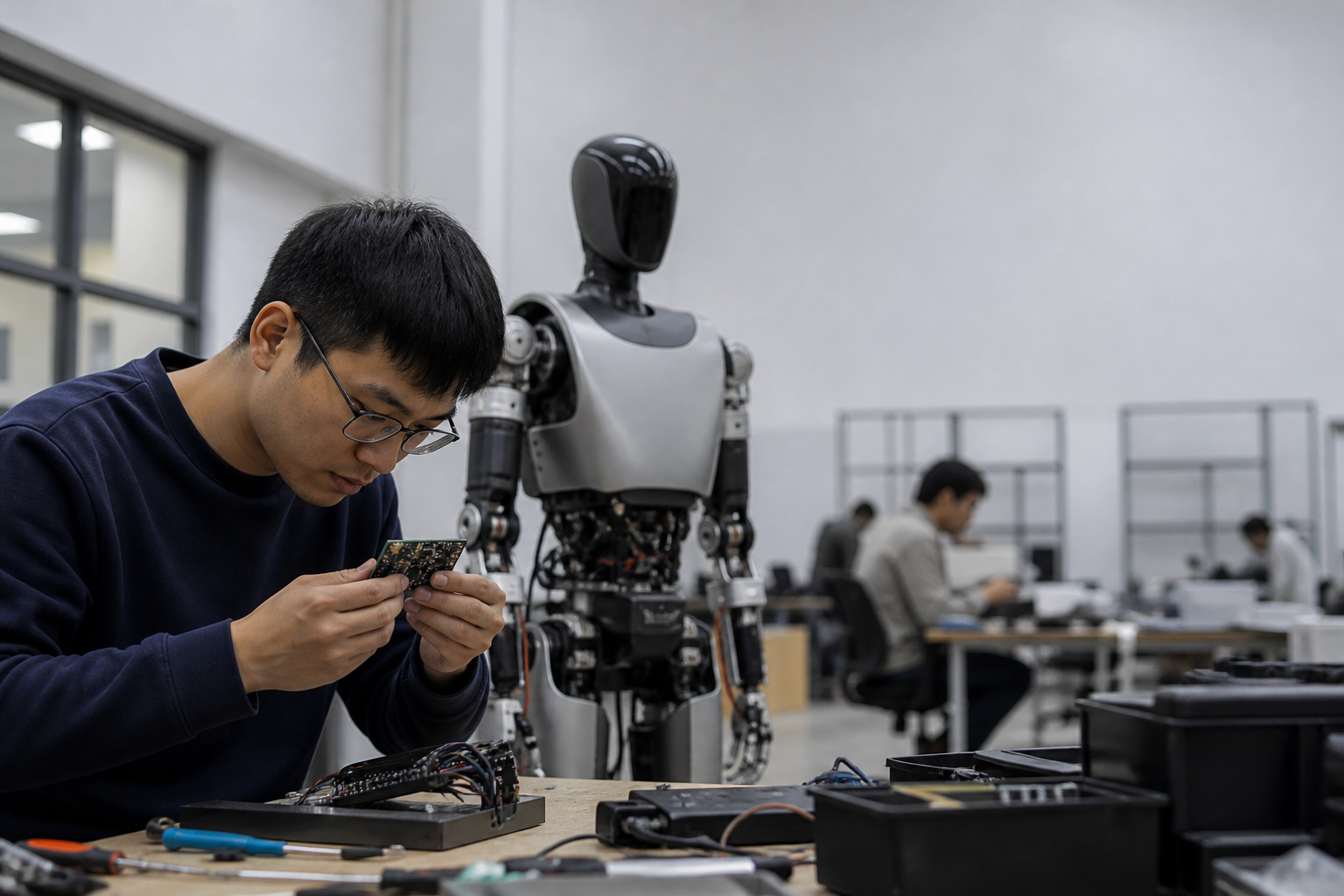
The more speculative element of the quarter is indie's push into what management calls Physical AI, meaning humanoid robots and autonomous mobile robots. A meaningful portion of the 2027 research and development budget is being redirected toward these applications. Management estimates content opportunity per humanoid robot platform at $100 or more.
The company has logged more than 40 vision design wins in 2026 across automotive, drone, and humanoid robot applications. The strategic backlog stands at $6.2 billion, a figure management says deliberately excludes recent Physical AI design wins to keep the estimate conservative.
Separately, indie's iND880 vision processor is picking up customers partly because it requires no DRAM, the memory chip facing industry-wide scarcity. As management put it, "given the escalating issues with DRAM availability and pricing, our differentiated DRAM less solution, particularly for e mirror application is proving to be the perfect fit."
Profitability timeline and liquidity
Management targets non-GAAP operating profitability in the second quarter of 2027 and cash-flow positivity in the third quarter of that year. Existing cash of $144.3 million, plus the $135 million expected from the Wuxi sale, is described as sufficient to reach those milestones without additional financing.
Fourth-quarter non-GAAP operating expenses are guided to $37.5 million, up slightly from $36.4 million in the third quarter.
The practical question for investors is whether the Physical AI revenue materializes on a timeline that justifies the R&D reallocation. The $6.2 billion backlog and the 40-plus vision design wins are leading indicators, but design wins in emerging robotics applications can take years to convert to meaningful shipment volumes. The radar ramp, with its named tier-one customer and stated unit targets, is the nearer-term test of whether management's production transition holds.
Sources
1. indie Semiconductor INDI Q3 2026 Earnings Call Transcript, fool.com
2. indie Semiconductor, Inc. - Form 8-K - FY2026, sec.gov
Bear Creek Capital Network publishes content for informational and educational purposes only. Nothing in this article constitutes financial, investment, tax or legal advice, or a recommendation to buy or sell any security. Consider your own circumstances and consult a qualified professional before making financial decisions.