Economy
Slow Growth From Automation May Be a Savings Problem, Not a Technology Problem
By Bear Creek Staff, . Bear Creek Capital Network.
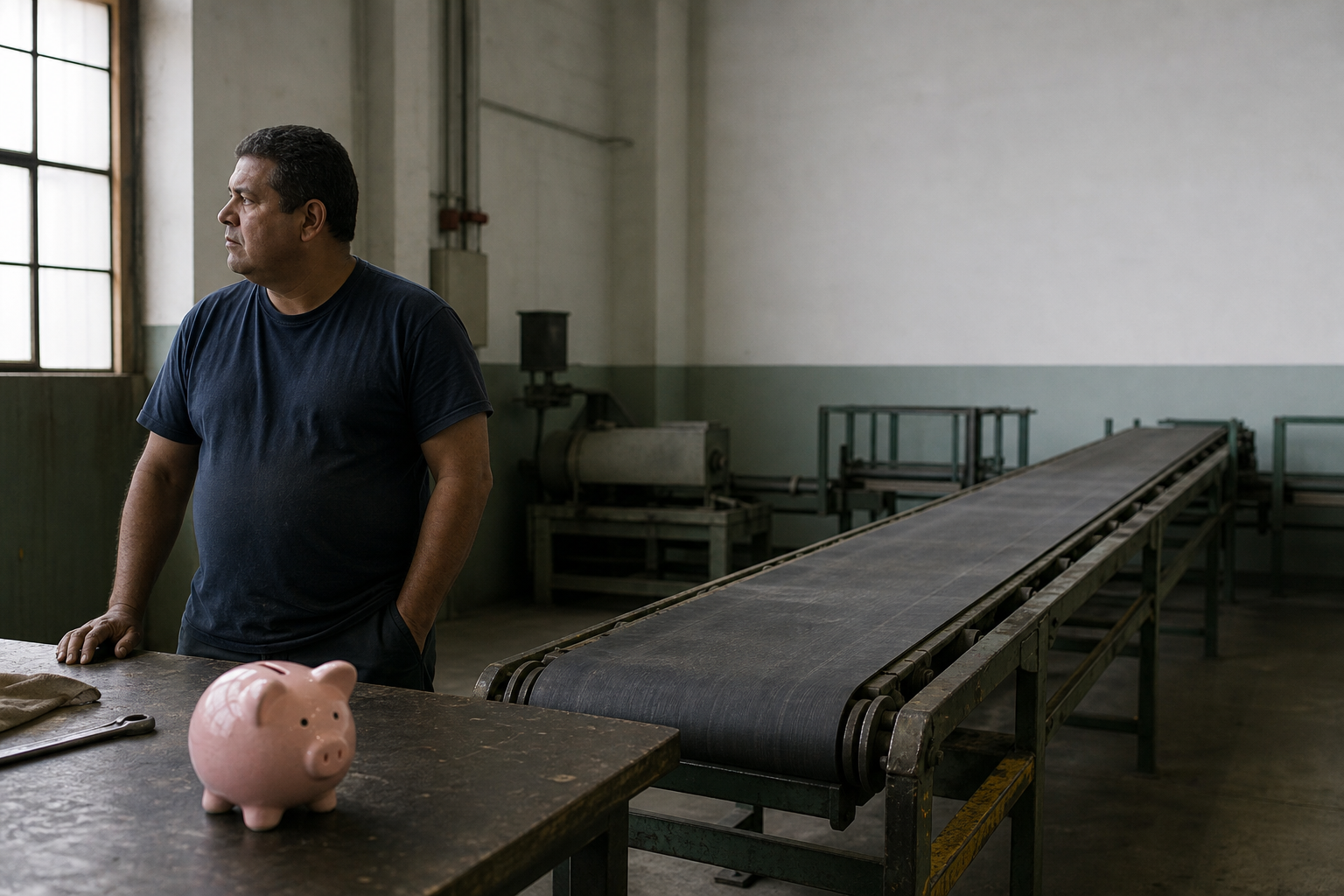
The question of how much automation actually lifts growth has a new and uncomfortable answer: it depends heavily on whether households save enough to fund the machines.
Economist Jesús Fernández-Villaverde has circulated a paper, flagged by Marginal Revolution, arguing that in a standard task model of the economy, capital supply (the stock of machines and other productive assets that accumulates when households save and invest) determines the size of any growth boom from automation, while the structure of tasks determines how long that boom lasts and what happens to wages along the way.
The central finding
The gap is large. Fernández-Villaverde writes that "the same technology path that generates 11.7% annual growth when households choose their saving rate optimally delivers only 2.2% when the saving rate is fixed at the calibrated U.S. 2025 level of 23%." That is a gap of more than nine percentage points from the same underlying technology, depending entirely on how much capital accumulates behind it.
The paper also challenges a common assumption about why saving rates might rise during an automation wave. The increase, Fernández-Villaverde argues, comes mainly because automation raises the share of income going to capital rather than because households consciously decide to set more aside. The shift is structural, not a change in individual behaviour.
What the model says about interest rates
On financial markets, the model has a specific implication: long-term real interest rates (yields on bonds after stripping out inflation) would move sharply. The ten-year real yield, in his benchmark calibration, "jumps from 5.1% to 13.6% on impact" as markets price in the growth boom. These are model outputs, not forecasts, and they depend on the assumptions built into the calibration.
Who bears the cost
The distributional picture is harder. Hand-to-mouth households, those who spend essentially all of their income and hold little or no savings, fare badly in this framework. Fernández-Villaverde puts their loss at the equivalent of two-fifths to two-thirds of their consumption. Keeping them on trend temporarily, rather than letting them absorb the full shock, costs at most a fifth of GDP in his benchmark case.
What the paper does not resolve
The model is, by construction, a stylised one. A "standard task model" makes assumptions about how tasks are divided between labour and machines, how substitutable they are, and how households respond to changing returns. Real economies deviate from those assumptions in ways that could compress or widen the gap between the 11.7% and 2.2% figures. The calibration to a 2025 US saving rate of 23% is a specific choice, and results would shift with it.
The paper, as summarised by Marginal Revolution, does not address the policy levers that would follow if capital accumulation is indeed the binding constraint, such as the tax treatment of saving and investment or the role of fiscal deficits in crowding out private capital formation. The full paper would need to be read for any treatment of those questions.
The practical trade-off
For a reader tracking AI's macroeconomic footprint, the paper reframes the debate: the question is not only what the technology can do, but whether the economy builds up enough capital to deploy it. A reader who accepts the model's logic gives up the assumption that faster invention automatically translates into faster growth, and gains a framework in which saving rates and capital returns become as important to watch as the technology itself. Whether real economies adjust quickly enough to close the gap the model identifies is, by the paper's own account, not automatic.
Bear Creek Capital Network publishes content for informational and educational purposes only. Nothing in this article constitutes financial, investment, tax or legal advice, or a recommendation to buy or sell any security. Consider your own circumstances and consult a qualified professional before making financial decisions.